Amblyopia: Understanding Vision Development and Patching Therapy for Children
 Dec, 4 2025
When a child’s vision doesn’t develop properly, it’s not just about seeing blurry. It’s about the brain ignoring one eye entirely - a silent, hidden problem called amblyopia, often known as "lazy eye." It’s the most common cause of vision loss in kids, affecting 2% to 4% of children worldwide. The scary part? Many parents never notice it until it’s too late. Unlike glasses that fix nearsightedness, amblyopia isn’t about the eye being damaged. It’s about the brain not learning how to use one eye properly. And if it’s not caught early, that vision loss can last a lifetime.
Why Amblyopia Happens: The Brain’s Choice
Amblyopia doesn’t happen because a child’s eye is broken. It happens because the brain decides to ignore input from one eye. This usually starts before age 3, during the most critical window for visual development - from birth to about age 7. During this time, the brain is building the pathways that connect the eyes to the vision center. If one eye sends a blurry, misaligned, or blocked image, the brain starts to favor the clearer one. Over time, it stops listening to the weaker eye altogether.
There are three main reasons this happens:
- Strabismic amblyopia - when one eye turns inward, outward, up, or down. The brain shuts off the misaligned eye to avoid double vision. This is the most common type, making up about half of all cases.
- Anisometropic amblyopia - when one eye has a much stronger prescription than the other. If one eye sees clearly and the other sees blurry all the time, the brain ignores the blurry one. This often goes unnoticed because the child can still see fine with the good eye.
- Deprivation amblyopia - when something physically blocks light from entering the eye, like a cataract, droopy eyelid (ptosis), or clouded cornea. This is the most serious type because the eye isn’t just underused - it’s starved of visual input.
Some kids even develop amblyopia in both eyes, usually when both eyes have very high prescriptions that aren’t corrected early. Premature birth, low birth weight, and family history raise the risk too. Kids with developmental delays are also more likely to have it.
How Doctors Diagnose It
Most parents won’t notice amblyopia. Kids don’t know their vision is different. They don’t say, "I can’t see well with my left eye." They just adapt. That’s why regular eye checks are non-negotiable.
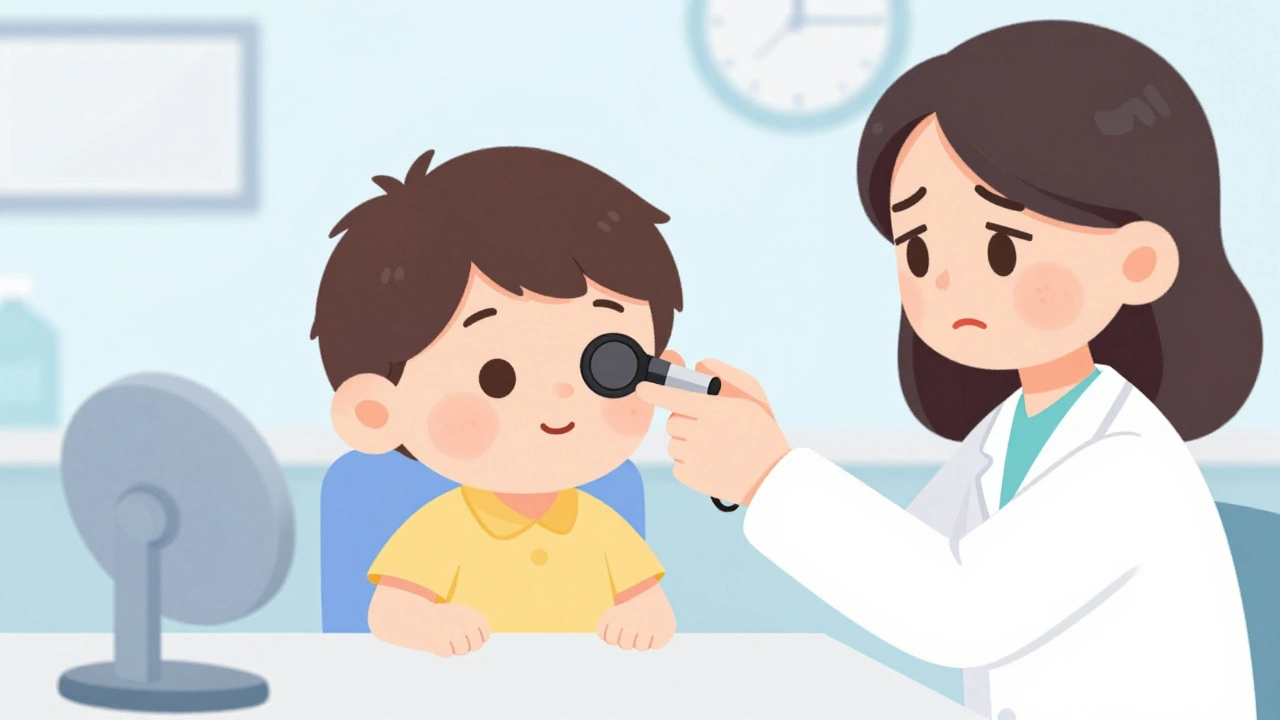
The American Academy of Pediatrics recommends vision screening at ages 1, 3, and 5. A simple test - covering one eye at a time - can reveal if a child reacts strongly when one eye is blocked but ignores the other. But a full diagnosis needs more:
- Visual acuity tests using picture charts or letter charts for older kids
- Refraction to check for glasses prescriptions
- Eye alignment tests to spot strabismus
- Fundus exam to rule out cataracts or other eye diseases
Without these tests, amblyopia stays hidden. And once a child turns 8, the chances of full recovery drop sharply.
Patching Therapy: The Gold Standard
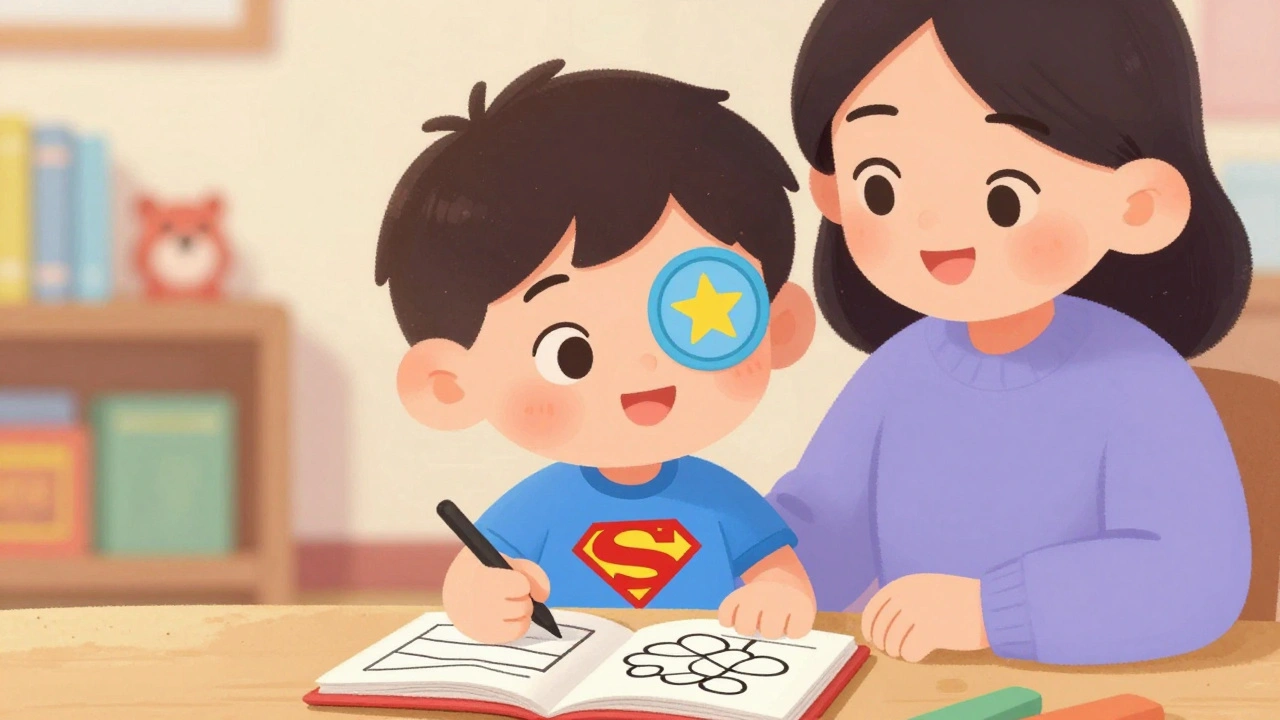
The most proven, time-tested treatment is patching - covering the stronger eye to force the brain to use the weaker one. It sounds simple, but it’s not easy. The goal isn’t just to cover the eye. It’s to rewire the brain.
For decades, doctors told parents to patch 6 hours a day. But research changed that. The landmark Amblyopia Treatment Study (ATS) showed that for moderate cases (vision between 20/40 and 20/100), just 2 hours of daily patching works just as well. That’s a game-changer. Less time patching means fewer tantrums, less skin irritation, and better compliance.
But here’s the hard truth: only 40% to 60% of kids stick with it. Parents report kids ripping off patches at school, crying during dinner, refusing to wear them at all. That’s why successful treatment isn’t just about the patch - it’s about the strategy.
Making Patching Work: Real-World Tips
Parents who get results don’t just slap on a patch and hope for the best. They build routines.
- Start slow - 30 minutes a day, then add 15-minute blocks every few days.
- Use patching as part of quiet time - reading, drawing, tablet games. Make it a calm, focused activity.
- Turn it into a game. "Today’s patch is a superhero mask!" Reward systems with stickers or small prizes help.
- Use digital tools. Apps like "LazyEye Tracker" let parents log hours and get reminders. Over 20% of pediatric eye clinics now recommend them.
- Don’t isolate the child. Let them wear patches with friends. Normalizing it reduces shame.
One clinic in Dublin found that when parents got a 30-minute counseling session explaining how the brain rewires itself, 89% of families followed through. Without that explanation, only 45% did. Knowledge isn’t power - it’s compliance.
Alternatives to Patching
Not every child tolerates patching. That’s why other options exist.
Atropine drops - a drop of 1% atropine in the strong eye once a day blurs near vision. The child then uses the weaker eye to read or play. Studies show it works just as well as patching for moderate amblyopia, with 79% of kids reaching 20/30 vision or better in 6 months. The big plus? No patch to remove, no skin rash. The downside? Some kids get light sensitivity or red eyes.
Bangerter filters - these are sticky, frosted stickers applied to the lens of the strong eye’s glasses. They blur vision just enough to encourage use of the weaker eye. They’re less noticeable than a patch, so older kids prefer them. They work about 60-70% of the time.
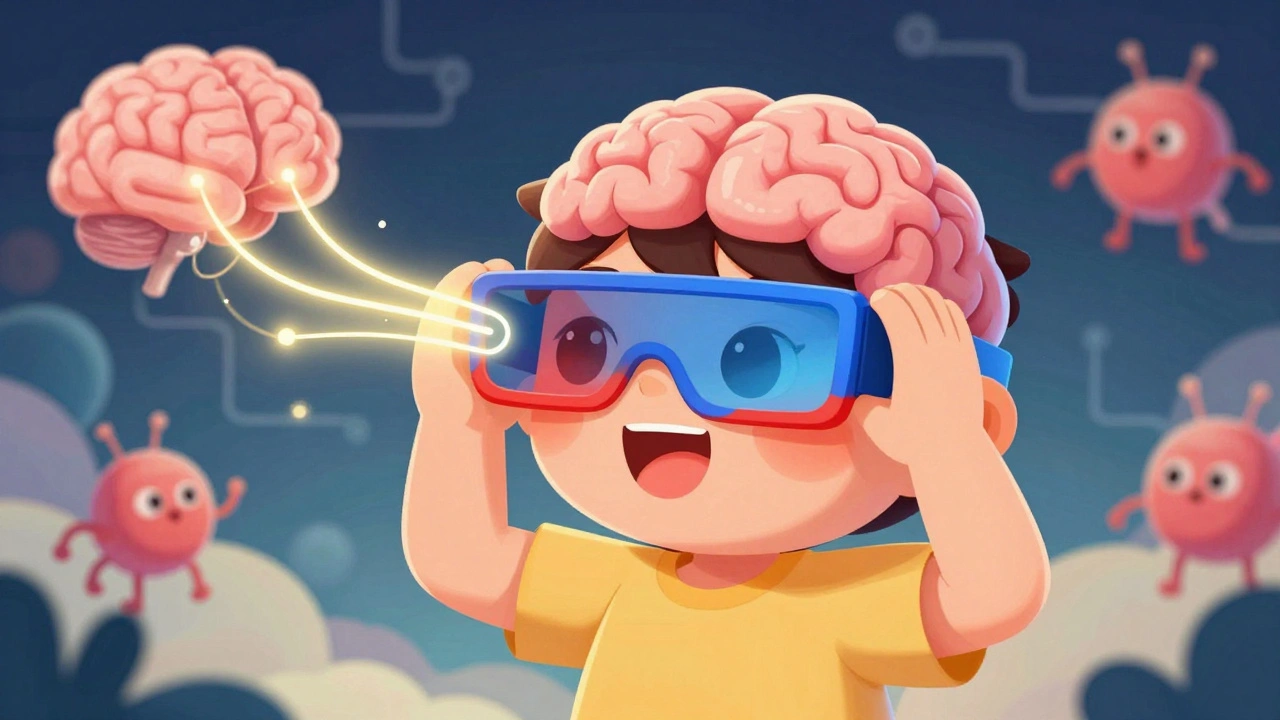
Digital therapy - platforms like AmblyoPlay use video games designed to stimulate the weaker eye. Kids wear special glasses with red-blue lenses while playing. The game forces both eyes to work together. In European clinics, compliance hits 75% - far higher than patching. It’s FDA-cleared and gaining traction in the U.S. too.
When Surgery Is Needed
If amblyopia is caused by a cataract or droopy eyelid, the blockage must be removed first. Surgery to fix strabismus (eye turn) may also be needed - but even after surgery, patching or atropine is still required. In fact, 70-80% of kids who have eye alignment surgery still need weeks or months of patching to get their vision back.
How Long Does Treatment Take?
There’s no quick fix. Most kids need treatment for 6 to 12 months. Some need it longer. Follow-up visits every 4 to 8 weeks are critical. Doctors check vision with acuity tests and adjust patch time based on progress. Stopping too soon is a common mistake. Vision can regress if the brain reverts to ignoring the weaker eye.
What Happens If It’s Not Treated?
Without treatment, amblyopia doesn’t go away. It gets worse. The brain permanently shuts down the connection to that eye. Even if glasses or surgery fix the eye’s structure later, the brain won’t know how to use it. That child will always have reduced depth perception, trouble with fine motor tasks, and a higher risk of permanent vision loss if the good eye gets injured.
And here’s something most people don’t know: treatment isn’t just for kids. New research shows adults with amblyopia can improve vision with intensive perceptual training - but the gains are small, slow, and nowhere near as good as childhood treatment. The window closes, and it doesn’t reopen.
Why Early Screening Is Everything
Children treated before age 5 recover 85-90% of their vision. Between ages 5 and 7, that drops to 50-60%. After age 8, improvement is rare and usually partial. That’s why the American Academy of Pediatrics says every child needs a vision screen by age 3.
It’s not about waiting for complaints. It’s about catching it before the brain makes its decision. A simple, 5-minute screening at the pediatrician’s office can change a child’s future. Glasses, patches, drops - these are tools. But the real cure is time. The earlier you start, the better the outcome.
What’s Next for Amblyopia Treatment?
Research is moving fast. A new technique called transcranial random noise stimulation (tRNS) - a mild electrical current applied to the scalp - is in clinical trials. Early results show it boosts patching outcomes by 40%. Digital therapies are becoming more advanced, with AI adjusting game difficulty based on real-time eye tracking.
But none of these replace the basics: early detection, consistent treatment, and parental support. The future of amblyopia care isn’t about fancy gadgets. It’s about making sure every child gets screened, every parent understands why patching matters, and no child loses vision because no one looked closely enough.
Can amblyopia fix itself without treatment?
No. Amblyopia does not fix itself. The brain learns to ignore the weaker eye, and without intervention, that suppression becomes permanent. Even if the underlying issue - like a cataract or eye turn - is corrected later, the vision won’t improve unless the brain is retrained through patching, drops, or therapy.
Is patching painful or harmful to the eye?
No, patching is not painful or harmful. It doesn’t damage the eye being covered. The only side effects are temporary skin irritation from adhesive patches or frustration from the child. These are manageable with proper patch types, rotation of placement, and behavioral strategies. The goal is to strengthen the weaker eye - not to harm the stronger one.
How long should a child wear a patch each day?
It depends on the severity. For moderate amblyopia, 2 hours a day is just as effective as 6 hours, according to major clinical trials. For severe cases, doctors may recommend 4 to 6 hours. Treatment starts low - even 30 minutes - and increases gradually. The key is consistency, not hours. Daily use matters more than long, sporadic sessions.
Can older children or teens still benefit from treatment?
Yes, but results are less predictable. Children aged 7 to 12 can still improve vision with treatment, especially if they’ve never been treated before. Studies show up to 50% of older kids gain 2 or more lines on the eye chart. But the chance of full recovery drops significantly after age 8. Treatment after age 12 is possible but requires more effort and yields smaller gains.
Do kids need to wear glasses if they have amblyopia?
Often, yes. Many cases of amblyopia are caused by uncorrected refractive errors - like farsightedness, nearsightedness, or astigmatism. Glasses correct the blur that’s causing the brain to ignore the eye. Patching or atropine won’t work well unless the glasses are worn consistently. Glasses are the foundation of treatment in most cases.
Can amblyopia come back after treatment?
Yes, if treatment stops too early or follow-up care is skipped. Vision can regress in the first few months after stopping patching. That’s why doctors recommend gradual tapering - reducing patch time slowly over weeks - and regular checkups for at least 6 months after treatment ends. Stopping abruptly increases the risk of relapse.
Jennifer Patrician
December 5, 2025 AT 20:32Let me guess - the government is using patching to control kids’ brains so they don’t see the truth about 5G eye implants. I’ve seen the footage. Kids in school are being forced to wear patches while watching holograms of the moon landing. It’s not lazy eye - it’s mind control. And they’re hiding the real cure: magnetic eye drops from Area 51. I’ve got 17 screenshots.
Mark Curry
December 7, 2025 AT 02:04It’s wild how the brain just… gives up. Like it’s tired of the noise. I wonder if that’s how we all feel sometimes - when one part of us gets ignored too long. Maybe we’re all a little amblyopic in some way. Patching isn’t just for eyes. It’s for attention. For care. For not letting anyone get left behind.
🙂
Manish Shankar
December 7, 2025 AT 21:32Respected colleagues, I wish to express my profound appreciation for the clarity and scientific rigor exhibited in this exposition on amblyopia. As a medical practitioner from New Delhi, I can attest that early screening remains grossly underutilized in rural India, where optical refractive errors are frequently mistaken for developmental delays. The implementation of community-based vision screening programs, supported by government health initiatives, is not merely advisable - it is an ethical imperative.
Lynette Myles
December 8, 2025 AT 16:09Patching doesn’t work. It’s placebo. The brain doesn’t ‘rewire’ - that’s neuro-babble. Vision improves because kids stop crying and finally get glasses. The real fix? Stop lying to parents. And stop calling it ‘lazy eye.’ It’s not lazy. It’s ignored. And you’re the ones ignoring it.
Annie Grajewski
December 10, 2025 AT 12:08so like… patching is just forcing a kid to use their ‘bad’ eye… but what if that eye is actually seeing something the brain doesn’t wanna deal with? like… what if it’s seeing the truth? and the ‘good’ eye is just… brainwashing them with corporate-approved visuals? i mean, have you ever seen how bright screens are? they’re literally frying kids’ retinas. patching is just the tip of the iceberg. #sawthetruth
Katie Allan
December 12, 2025 AT 01:36This is one of the most important pieces of health information I’ve read all year. Every parent needs to hear this. Screening at age 3 isn’t optional - it’s lifesaving. And to the parents struggling with patching: you’re not failing. You’re fighting for your child’s future. One hour at a time. One sticker at a time. You’re doing better than you think.
Keep going. They see you.
Kylee Gregory
December 12, 2025 AT 06:11It’s fascinating how the brain prioritizes efficiency over accuracy. If one eye gives a clearer signal, it drops the other - like a manager cutting a redundant department. But the tragedy is, that ‘redundant’ eye isn’t broken. It’s just unheard. Maybe we’re all guilty of this - ignoring the quiet voices around us because they’re harder to hear. Patching is just a physical version of listening when it’s inconvenient.
Lucy Kavanagh
December 13, 2025 AT 06:37Did you know the NHS stopped funding patching in 2019 because it was ‘inefficient’? That’s right. They replaced it with ‘digital therapy’ - which is just video games made by tech giants who don’t care about kids. Now they’re pushing atropine because it’s cheaper. Don’t be fooled. This isn’t medicine. It’s cost-cutting. And your child’s vision is the sacrifice. I’ve seen the memos. It’s all documented.
Chris Brown
December 14, 2025 AT 18:19Let me be perfectly clear: if you are allowing your child to wear a patch without a signed consent form from a licensed neuro-ophthalmologist, you are committing medical negligence. The brain’s plasticity is not a playground. You are not a parent. You are an experiment. And I have seen the results. Children with permanent eye suppression. And for what? To save 15 minutes a day? Shame on you.
sean whitfield
December 15, 2025 AT 16:35patching is just a distraction. the real problem? sugar. processed food. blue light. the brain ignores the eye because it’s busy trying not to melt. no one talks about this because the eye industry makes more money selling patches than selling kale. i’ve been tracking this since 2017. the data is clear. stop patching. start juicing.