FDA Orange Book: How to Find Patent Expiration Dates and What They Mean
 Jul, 31 2026
Have you ever wondered why some drugs have cheap generic versions while others stay expensive for years? The answer usually lies in a specific government database called the FDA Orange Book, officially known as Approved Drug Products with Therapeutic Equivalence Evaluations. This resource is the go-to place for finding out when patent protections expire, allowing generic competitors to enter the market. If you are trying to figure out if a cheaper alternative is coming soon, or if you work in pharmaceuticals and need to plan a product launch, knowing how to navigate this tool is essential.
The Orange Book was created under the Drug Price Competition and Patent Term Restoration Act of 1984, commonly referred to as the Hatch-Waxman Act. It lists all approved nonbiologic (small-molecule) drugs in the United States along with their associated patents and exclusivity periods. While it might look like just another list on the FDA website, getting the wrong date here can cost companies millions or delay patient access to affordable medication. Let's break down exactly where to find these dates and, more importantly, how to interpret them correctly.
How to Locate Patent Expiration Dates in the Electronic Orange Book
First things first: you need to know where to look. The printed version is long gone; today, everything lives online in the Electronic Orange Book. You can access it directly through the FDA’s CDER portal. Here is the step-by-step process to find the specific expiration date for a drug:
- Go to the Search Page: Navigate to the main search interface at the FDA Orange Book URL.
- Enter Your Criteria: You can search by active ingredient (the chemical name), proprietary name (brand name), application number, or applicant (the company holding the patent).
- Select the Product: Once the results load, click on the hyperlinked Application Number for the specific drug product you are interested in.
- View Detailed Info: On the next page, scroll down and click the View option. This opens the detailed record containing all listed patents and exclusivities.
In this detailed view, you will see a table listing various patents. Look specifically for the column labeled Patent Expire Date. This field shows the date the patent expires, including any applicable extensions, formatted as MMM DD, YYYY. For example, if you look up a well-known cardiovascular drug like Brilinta, you might see multiple entries with different expiration dates ranging from past dates to future ones. These variations exist because different aspects of the drug-such as its formulation, method of use, or delivery system-are protected by separate patents.
Understanding the Data: Patents vs. Exclusivity
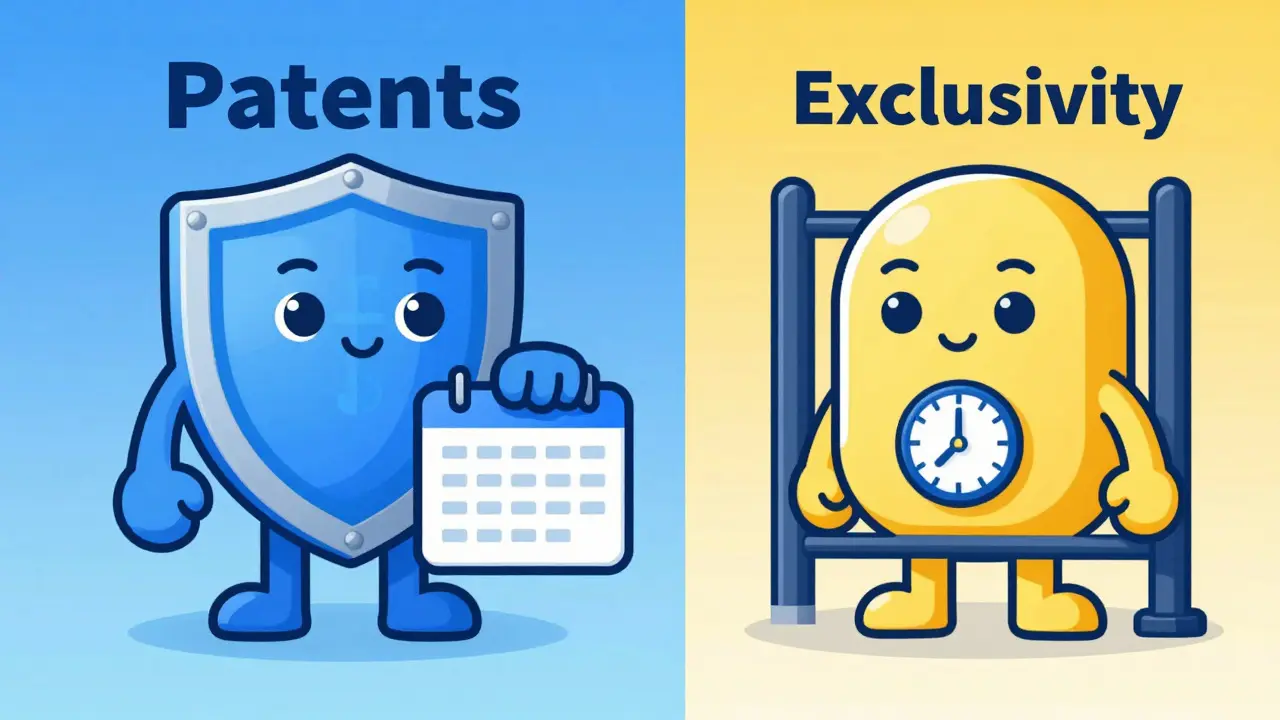
Finding the date is only half the battle. Understanding what that date actually means is where most people get tripped up. The Orange Book tracks two distinct types of protection: patents and regulatory exclusivity. They sound similar but operate differently.
Patents are intellectual property rights granted by the USPTO. They protect inventions, including new molecules or unique manufacturing processes. In the Orange Book, you will see the patent number, expiration date, and a Patent Use Code. This code is an alphanumeric identifier (like U-001) that describes exactly what the patent covers. Is it the core molecule? A specific dosage form? A method of administration? Checking the use code is crucial because a generic manufacturer might be able to launch a product that avoids infringing on a specific use code even if the primary patent hasn't expired yet.
Regulatory Exclusivity, on the other hand, is a period during which the FDA is barred from approving a generic version, regardless of patent status. This often applies to new chemical entities or drugs with new clinical studies. Unlike patents, exclusivity periods don't always appear as simple expiration dates in the same way. Instead, they act as a gatekeeper. Even if a patent expires tomorrow, if a drug still has three months of pediatric exclusivity left, no generic can be approved until that clock runs out.
| Feature | Patents | Exclusivity |
|---|---|---|
| Governing Body | USPTO (United States Patent and Trademark Office) | FDA (Food and Drug Administration) |
| Purpose | Protects invention/innovation | Prevents FDA approval of generics temporarily |
| Duration | Usually 20 years from filing, plus potential extensions | Varies (e.g., 5 years for NCEs, 3 years for new indications) |
| Challengeable? | Yes, via Paragraph IV certifications in court | No, must wait for period to end |
| Display in Orange Book | Listed with expiration dates and use codes | Listed separately, often extending patent dates |
The Hidden Trap: Why Orange Book Dates Can Be Wrong
Here is the part that catches many researchers off guard: the expiration date shown in the Orange Book is not always the true last day of protection. According to a study published in PMC analyzing the NBER Orange Book Dataset, about 46% of patents listed in the Orange Book expire early due to non-payment of maintenance fees. The FDA does not retroactively update listings for these early expirations. So, a patent showing an expiration date of 2030 might have actually lapsed in 2022 if the owner forgot to pay their renewal fee.
To avoid this pitfall, you should cross-reference the Orange Book data with the USPTO Patent Center. The NBER study found that 89% of patents with Patent Term Extensions (PTE) had identical dates in both databases, but that remaining 11% discrepancy rate is significant for business planning. Always verify the current legal status of a patent through USPTO records before making major decisions based solely on the Orange Book.
Another complexity involves Pediatric Exclusivity. When a drug receives this 6-month bonus period, the Orange Book displays the patent twice. One entry shows the original expiration date, and the second shows the extended date reflecting the pediatric addition. If you aren't looking closely, you might miss the extension and assume the patent has already expired.
Using Bulk Data Files for Advanced Analysis
If you are analyzing hundreds of drugs rather than just one, clicking through the web interface is inefficient. The FDA provides Orange Book Data Files that are updated daily. These downloadable files contain complete patent information in structured formats, perfect for importing into Excel or SQL databases.
When working with these files, pay attention to these key columns:
- Product No: Identifies the specific drug product.
- Patent No: The US patent number.
- Patent Expiration: The expiration date including extensions.
- Drug Substance Flag: Indicates 'Y' if the patent claims the drug substance itself (submitted after August 18, 2003).
- Patent Delist Request Flag: Shows 'Y' if the sponsor requested the patent be removed. Note that even if delisted, the patent may remain visible to preserve eligibility for 180-day exclusivity for generic applicants.
These bulk files also include submission dates, though keep in mind the FDA only started collecting this data systematically in 2013. Records prior to that will lack this timestamp.

Why This Matters for Generic Market Entry
For generic manufacturers, the Orange Book is a roadmap. The goal is often to file an Abbreviated New Drug Application (ANDA) with a Paragraph IV Certification. This certification states that the generic maker believes the listed patent is invalid, unenforceable, or will not be infringed. Doing so triggers a 30-day window for the brand-name holder to sue. If they do, a 30-month stay on FDA approval begins. However, if no lawsuit is filed, or if the generic wins, they can launch early.
The first generic company to successfully challenge a patent and get approved may qualify for 180-day exclusivity. During this period, no other generics can enter the market. This makes identifying which patents are weak or nearing expiration incredibly valuable. Industry analysts predict that by 2025, nearly 78% of brand-name drug revenue will face generic competition. Accurate interpretation of these dates helps forecast market shifts and pricing strategies.
Recent Changes and Transparency Improvements
The landscape isn't static. The Orange Book Transparency Act (OBTA) of 2020 pushed for greater clarity. As a result, the FDA implemented updates in late 2021 and early 2022 to refine how patent information is listed and removed. These changes aimed to reduce ambiguity around when patents should be delisted upon expiration or invalidation.
The user interface has also improved. In November 2022, the FDA launched better search filters and a "View All Patents" feature to address complaints about the site's complexity. Despite these improvements, users still report challenges with accessibility and interpreting complex use codes. The FDA continues to publish guidance documents, such as "The Listing of Patent Information in the Orange Book," to help stakeholders navigate these rules.
Is the FDA Orange Book free to use?
Yes, the Electronic Orange Book and its data files are completely free to access and download from the FDA website. There are no subscription fees required.
Does the Orange Book list biologic drugs?
No, the Orange Book specifically covers approved nonbiologic (small-molecule) drug products. Biologics are listed in a separate database called the Purple Book.
What does a 'Delist Requested' flag mean?
It means the patent holder has asked the FDA to remove the patent from the listing. This often happens if the patent has been invalidated in court or is no longer considered enforceable, though it may remain visible temporarily to protect generic exclusivity rights.
Can I rely solely on the Orange Book for patent validity?
Not entirely. While the Orange Book is the official registry for FDA approval purposes, it does not track maintenance fee payments. You should verify patent status with the USPTO to ensure the patent hasn't expired early due to non-payment.
How often is the Orange Book updated?
The electronic database is updated frequently, with daily data file updates available for download. The web interface reflects the most recent submissions and approvals as processed by the FDA.