Specific IgE Testing: How to Identify Allergens and Understand Your Results
 Jan, 21 2026
What Is Specific IgE Testing?
Specific IgE testing is a blood test that measures how much of a certain type of antibody-called immunoglobulin E (IgE)-your body has made in response to a specific allergen. These allergens could be things like peanuts, cat dander, pollen, or milk. When your immune system thinks these harmless substances are dangerous, it produces IgE antibodies. The test finds and measures those antibodies in your blood.
This isn’t a new idea. Back in the 1970s, doctors used something called the RAST test, which could only say whether IgE was present or not. Today, we use far more precise tools like ImmunoCAP, which gives a number-measured in kUA/L-that tells you exactly how much IgE is there. That number matters. A result of 0.5 kUA/L is very different from 15 kUA/L, even though both are above the normal range.
Why Doctors Order This Test
You don’t get this test just because you think you might be allergic. Doctors only order it when your symptoms and history suggest an IgE-mediated allergy. That means: did you break out in hives right after eating shellfish? Did your eyes swell up after petting a dog? Did you have trouble breathing after eating peanuts? If yes, then this test helps confirm it.
It’s also used when skin testing isn’t possible. If you have severe eczema covering half your body, or if you’re taking antihistamines, antidepressants, or other meds that block skin test results, blood testing is your best option. About 27% of kids in pediatric allergy clinics get this test because they can’t stop their meds for the 3-5 days needed before a skin test.
And yes, it’s used to plan immunotherapy. If you’re considering allergy shots or under-the-tongue drops, knowing exactly what you’re allergic to is essential. You don’t want to inject someone with something they’re not actually allergic to.
How the Test Works
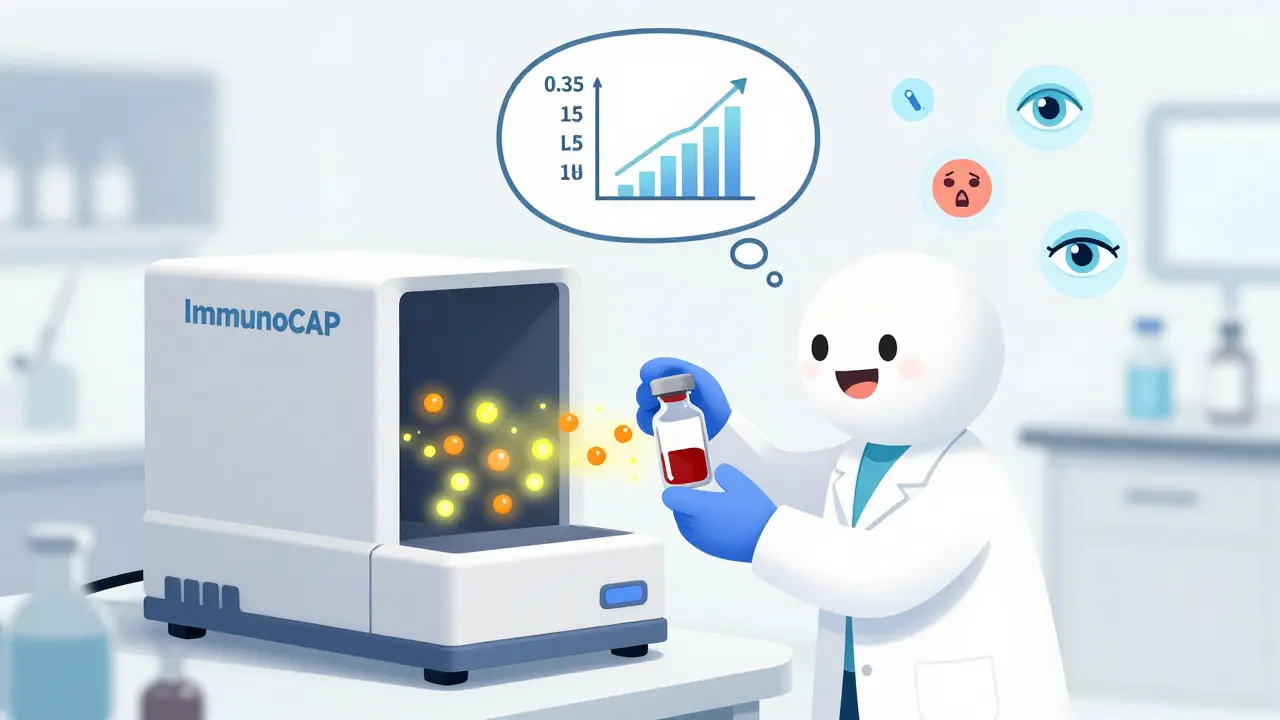
The process is simple. A nurse draws about 2 mL of blood-just one vial-into a yellow-top tube. That’s it. No fasting, no special prep. The lab then uses a method called Fluorescence Enzyme Immunoassay (FEIA). In simple terms, the blood is mixed with tiny beads coated with the allergen you’re being tested for. If your blood has IgE antibodies for that allergen, they stick to the bead. A special fluorescent dye then lights up, and the machine measures how bright it gets. Brighter = more IgE.
The most common platform used in labs today is ImmunoCAP. It’s accurate, reliable, and used in 85% of UK labs. Other platforms like HyCor’s HYTEC 288 are also used, but ImmunoCAP is the gold standard. Results come back in about 3 days. Some rare allergens may need to be sent to specialized labs, which can add extra time.
Reading Your Results: Numbers, Not Just Yes or No
Your result won’t say ‘positive’ or ‘negative.’ It’ll give you a number: 0.1 kUA/L, 1.2 kUA/L, 18.5 kUA/L, and so on. The reference range is simple: anything under 0.35 kUA/L is considered normal. That’s the cutoff.
But here’s where people get confused. A result of 0.5 kUA/L doesn’t mean you’re ‘a little allergic.’ It just means you have detectable IgE. The real question is: does that match your symptoms? A 0.5 kUA/L result for peanut in someone who’s never had a reaction means almost nothing. But a 15 kUA/L result for peanut in someone who collapsed after eating a cookie? That’s a strong signal.
Professor Richard Lockey put it this way: the chance that you’re truly allergic to peanut jumps from 50% at 0.35 kUA/L to 95% at 15 kUA/L. That’s the power of quantitative testing. Higher numbers usually mean higher risk of a severe reaction.
Also, your total IgE level matters. If your total IgE is 100 kUA/L and your peanut-specific IgE is 0.5 kUA/L, that’s only 0.5% of your total. But if your total IgE is 1 kUA/L and your peanut-specific is 0.5 kUA/L, that’s half your immune system’s focus on peanut. That’s a big difference.
What the Test Can’t Do
Specific IgE testing doesn’t diagnose everything. It only finds IgE-mediated allergies. It won’t tell you if you have a food intolerance, like lactose intolerance. It won’t tell you if you have a delayed reaction, like eczema flare-ups from dairy that take hours to appear. It won’t diagnose non-IgE allergies like eosinophilic esophagitis.
And it’s not a screening tool. Testing for 20 allergens at once is a bad idea. Studies show that when you test for more than 12 allergens, false positives jump to 60%. Why? Because random IgE can bind to things it shouldn’t. That’s why guidelines say: test only what makes sense based on your history.
Don’t get food mix panels. These test for ‘tree nuts’ or ‘shellfish’ as a group. They’re inaccurate. You might test positive for a mix, but it could be cashew you’re allergic to-not walnut. That’s dangerous if you avoid all nuts unnecessarily. Always test individual allergens.
When Skin Testing Is Better
Even though blood tests are convenient, skin prick testing is still the first choice when possible. Why? Because it shows real-time biological activity. When they prick your skin with an allergen, and you get a red, itchy bump, that means IgE on your mast cells triggered a reaction right there. It’s direct evidence.
Studies show skin tests are 15-20% more sensitive than blood tests for common allergens like pollen or dust mites. But that gap is shrinking. For some allergens-like peanut or egg-modern blood tests are now almost as good.
Still, skin testing can’t be done on people with widespread eczema, or those on antihistamines. It also carries a tiny risk of triggering a full-body reaction. Blood tests have no such risk. So the choice isn’t about which is ‘better.’ It’s about which is right for you.
What Comes After the Test?
Getting a result is just the start. The real work is connecting it to your life. A positive test doesn’t mean you have to avoid that food forever. Many people test positive but have eaten the food safely for years. That’s called ‘sensitization without clinical allergy.’
That’s why your doctor needs your history: When did symptoms start? How long after eating? What happened? Did you vomit? Break out in hives? Have trouble breathing? Did you need an EpiPen? That story is more important than the number on the page.
For food allergies, especially peanut, tree nuts, or shellfish, a high IgE level might mean you’re at risk for anaphylaxis. That’s when an allergist may recommend an oral food challenge-done under medical supervision-to see if you still react. Many people outgrow allergies, especially to milk, egg, or soy. Testing over time can show if your IgE levels are dropping.

Newer Advances: Component-Resolved Diagnostics
Some labs now offer something called component-resolved diagnostics. Instead of testing for whole peanut protein, they test for specific parts of it-like Ara h 2, which is the main trigger for severe reactions. This helps distinguish true peanut allergy from cross-reactivity with birch pollen (which can cause a mild oral itch but not anaphylaxis).
With this method, specificity for peanut allergy jumped from 70% to 92%. That’s huge. It means fewer people avoid peanuts unnecessarily. These tests are not yet routine. They’re mostly used in allergy centers and require expert interpretation. But they’re the future.
What to Avoid
Don’t test for things you’ve never eaten. Don’t test for 15 allergens just because your doctor offered a panel. Don’t test for mold if you’ve never had symptoms near damp buildings. Don’t retest for something you’ve eaten safely for 10 years.
One study found that 38% of inappropriate tests happened because the patient had a documented history of tolerance-but someone ordered the test anyway. That’s waste. That’s confusion. That’s risk.
And don’t panic over a low number. A 0.4 kUA/L result for milk doesn’t mean you’re allergic. If you’ve been drinking milk since you were a baby, you’re fine. Ignore the number. Trust your history.
Final Thoughts: It’s a Tool, Not a Diagnosis
Specific IgE testing is powerful-but only when used correctly. It’s not a magic wand. It’s a tool in the hands of a trained allergist. Used right, it can save lives by confirming life-threatening allergies. Used wrong, it can lead to unnecessary fear, avoidance, and even malnutrition.
If you’re considering this test, ask your doctor: ‘What am I testing for? Why now? And what will we do with the result?’ If they can’t answer those clearly, it might not be the right time.
What’s Next?
If your test confirms an allergy, you’ll likely be referred to an allergist. They’ll help you create a management plan: what to avoid, how to read labels, when to carry an epinephrine auto-injector, and whether immunotherapy might help. For some, that means years of avoidance. For others, it means eventual tolerance.
And if your test is negative? That’s good news-but don’t stop there. If your symptoms are real, there might be another cause. Non-IgE allergies, intolerances, or even environmental triggers like perfumes or pollution can mimic allergy symptoms. Keep working with your doctor. The answer is out there.
Chiraghuddin Qureshi
January 22, 2026 AT 23:28Kenji Gaerlan
January 24, 2026 AT 20:36Oren Prettyman
January 26, 2026 AT 19:12Liberty C
January 27, 2026 AT 08:54Neil Ellis
January 28, 2026 AT 04:14Lana Kabulova
January 29, 2026 AT 01:40Rob Sims
January 30, 2026 AT 16:26Tatiana Bandurina
January 30, 2026 AT 16:39Alec Amiri
January 31, 2026 AT 18:32Patrick Roth
February 2, 2026 AT 04:27Ryan Riesterer
February 2, 2026 AT 13:28Akriti Jain
February 3, 2026 AT 11:22